Days 0 – 4
It has been four days since I flew from JFK to Taiwan Taoyuan International Airport. After the 16 hour flight, I was ready to shower and eat some of the local food people rave about. Once we dropped off our luggage at our dorm, our advisor, Hedy (晨珺), took us to a small, local restaurant. There, we ate amazing noodles and discussed some of the cultural differences between America and Taiwan regarding ordering and eating food. I learned that, unlike America, people in Taiwan do not leave a tip after eating and that taxes are included in prices. Moreover, the cost of food is significantly cheaper. For instance, these past four days I have spent no more than $4 on breakfast and bought local food like pork buns and scallion pancakes for dinner that was less than $5 all together. However, when our class ate at restaurants this week, they were more expensive. Nevertheless, I am looking forward to eating at Din Tai Fung, a popular restaurant that originated in Taiwan in 1958 and has become popular in America as well.

After our first meal, we walked through the narrow, vibrant streets of Taipei and ventured into small shops. Typically, streets that do not have a lot of traffic are one-way and have a sidewalk that is integrated into the pavement at the same level as the cars; this means pedestrians have a higher chance of accidents. Regardless, it is essential for Taiwanese to use the city’s space efficiently since Taipei is such a highly populated area.
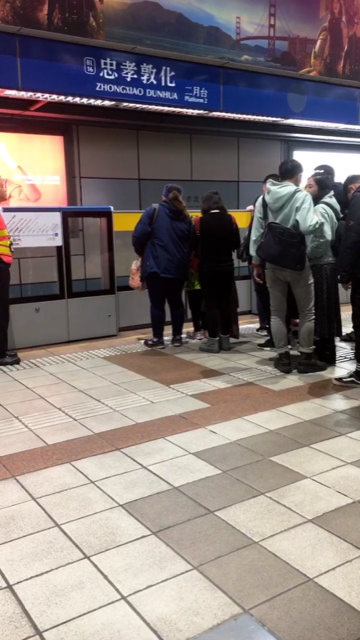
Not only is Taipei’s architecture remarkable, but it’s transportation, known as the MRT, is also very impressive. In order to go on daily excursions, our study abroad group often walks to the Dongmen Station. Naturally, the first time I rode in the MTR I was making comparisons to NYC’s subway system. Unlike NYC’s metro, the MTR is very clean; this is due to the substantial fine if one is to eat, drink or litter. Despite the fine, I believe that the Taiwanese society values being respectful to public areas by keeping them clean. Thanks to the MTR, people avoid navigating Taipei by car and bus. Due to the limited amount of space, cars often cause inconveniences in regards to traffic and parking. Aside from the MTR, motorcycles and mopeds are very popular since they can easily maneuver through the streets.
Throughout these four days, our group has had excursions to Chiang Kai-shek Memorial Hall, Taipei 101, Vigor Kobo Pineapple Shortcake Factory and Longshan Temple. Today, after visiting Longshan Temple, I heard Wang Leehom, a famous Taiwanese singer who was born in New York, was performing a free concert at Daan Forest Park. At the concert, my friend and I realized that the songs Leehom sang had subtitles. Similarly, at New Years Eve performance at Taipei 101, the singers had subtitles as they sang as well – perhaps the purpose of the subtitles is to accommodate different dialects. Nevertheless, it was very convenient to read the subtitles so we could practice our reading skills!

Tomorrow is our first day of Chinese class! I am excited about improving my speaking skills; although I can successfully order bubble tea in Mandarin, I am definitely looking to have more meaningful conversations.
 Explore Taiwan
Yes! I am also looking forward to Din Tai Fung! It is by far one of my favorite Taiwanese restaurants.
LikeLiked by 1 person
The crowd’s volume level at both concerts (both Wang Leehom and the one at Taipei 101) was also very different from volume levels at big American concerts. They were a lot quieter when the artist was singing, instead of screaming in excitement the whole time or singing along loudly with every song (some people did this with more popular songs but not every song). They only really got loud when the artist engaged with them. I feel like this is a respect thing too, both for the people around them and for the artist and his work.
LikeLiked by 1 person